
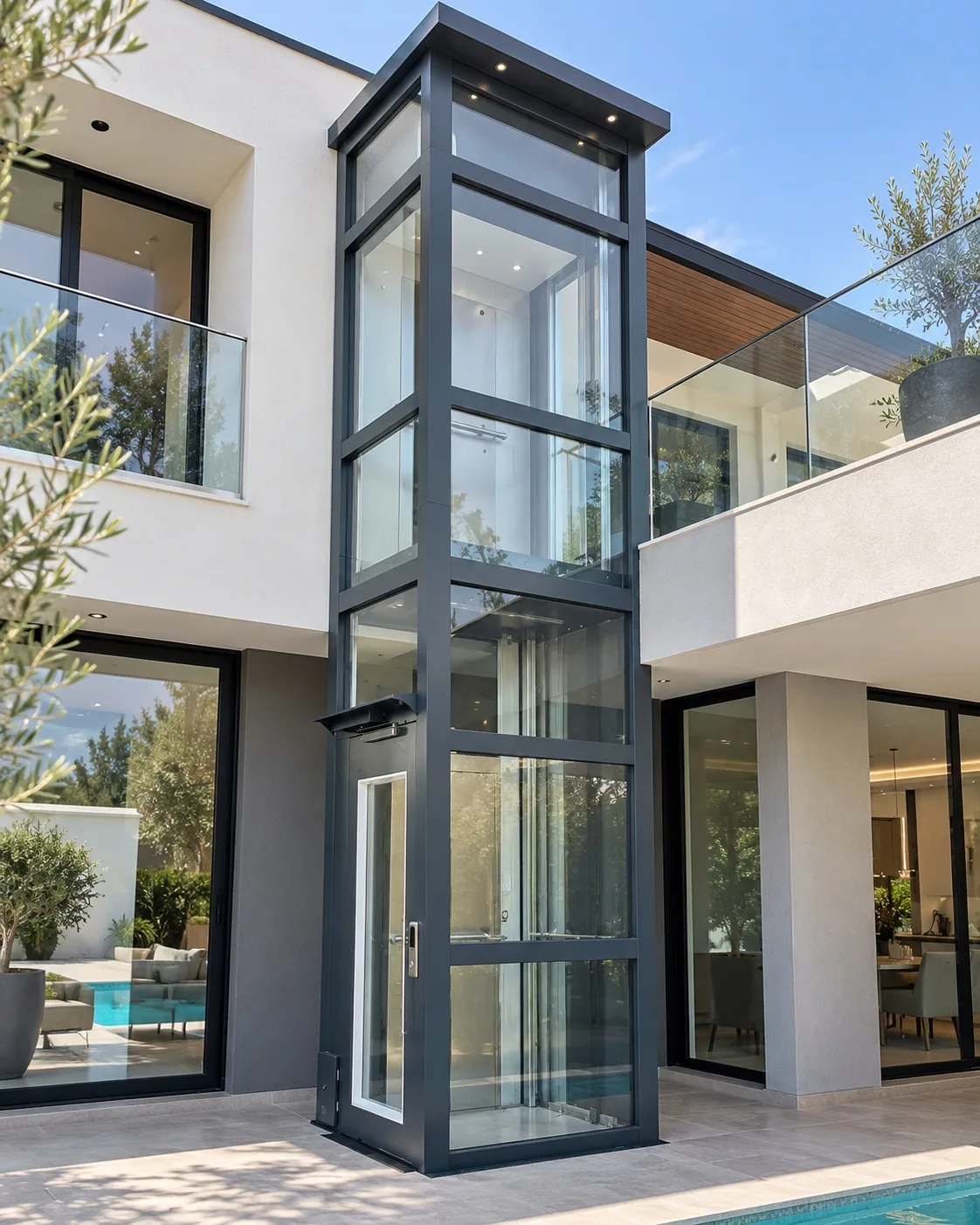
Whenever an incident involving lifting equipment appears in the news, it understandably attracts attention. Precisely because it is extraordinary, it makes headlines. However, when we look at the objective data on daily operation and the engineering principles behind passenger lifts and homelifts for detached houses, the technical conclusion is clear: vertical transport is the safest means of travel in existence.
The figures in Spain: over 200 million trips every single day
To put the reliability of these systems into perspective, it helps to look at the true scale of their operation in Spain. According to data from the Spanish Lift Business Federation (FEEDA), Spain has the largest fleet of passenger lifts in the European Union:
- More than 1.15 million lifts and platform lifts in operation across private homes, residential buildings, hotels, hospitals, shops and public buildings.
- Over 200 million trips per day in Spain alone — equivalent to more than 70 billion journeys every year.
- Hundreds of millions of passengers moved smoothly, quietly and without incident every single day.
Against those 70+ billion annual journeys, fatal accidents in certified passenger lifting equipment are statistically close to zero. In terms of probability per trip, riding in a certified lift or homelift is orders of magnitude safer than travelling by car, and even safer than walking up or down a conventional staircase, where domestic falls number in the thousands every year.
Why a serious accident is never "normal": a chain of concurrent causes
In safety engineering there is a core principle known as the multiple-barrier model (or "Swiss cheese" model): a certified machine designed to lift people never relies on a single component to keep passengers safe. It is engineered with several independent physical, mechanical and electronic layers of protection.
For that reason, a certified and properly maintained lift or homelift plummeting due to the isolated failure of a single component is technically implausible. For a severe accident with fatal consequences to occur, an exceptional chain of anomalous factors — which should never coincide — has to align simultaneously:
- Equipment not certified or not intended for people: using goods-only industrial hoists, building-site winches or uncertified home-made devices to carry people, lacking mechanical safety gear and mandatory protective devices.
- Tampering with or bypassing safety circuits: interventions by unqualified individuals that disable sensors, door interlocks or mechanical retention systems.
- Prolonged absence of maintenance and inspection: installations operating outside the official register, without preventive servicing or periodic regulatory inspections for years, allowing critical wear or corrosion to go uncorrected.
- Structural failures external to the lifting unit or extreme overloading far beyond the generous design safety margins.
In short: a fatal accident does not happen because "the lift simply broke one day"; it happens only when several technical, human and regulatory barriers are breached one after another.
What mechanical barriers protect a modern homelift or lift?
Both a conventional passenger lift and a residential homelift or platform lift operating at up to 0.15 m/s incorporate redundant fall-arrest systems that act on purely physical principles — even in the event of a total power cut:
- Mechanical safety gear and overspeed governor: if the cabin or platform ever exceeds its rated downward speed, a centrifugal mechanism triggers mechanical wedges that grip the steel guide rails and bring the carrier to a halt within a few centimetres. It is the principle that made modern vertical transport possible and remains fail-safe today.
- Rupture valve (pipe-break valve) in hydraulic units (such as the SCA-H): fitted directly to the base of the hydraulic cylinder. If it detects a flow rate higher than normal (for example, in the hypothetical event of a hose failure), it closes instantaneously through physical fluid pressure and locks the oil inside the cylinder, preventing the cabin from descending.
- Dual safety nut in screw-driven units (such as the SCA-T): a screw-and-nut drive is mechanically self-locking by geometry. In addition, it features an independent secondary safety nut beneath the main load-bearing nut with electronic wear monitoring: if the primary nut ever developed play, the backup nut supports the load and prevents the unit from restarting until serviced.
- High structural safety factors: suspension elements, guide rails and structural anchors are calculated to withstand several times the rated maximum load of the appliance.
- Electromechanical door interlocks: no landing door can be opened unless the cabin is stationary at that floor, and the unit cannot move unless every door is closed and mechanically locked.
- Battery-powered automatic rescue and two-way communication: if the household power supply fails, onboard batteries gently lower the cabin to the lowest landing and open the doors so the passenger can step out normally, alongside a built-in emergency telephone.
The three pillars that keep risk virtually at zero
True safety in vertical mobility is not a matter of luck; it rests on three links that are strictly regulated in Spain (as we explain in detail in our guide to homelift and platform lift regulations in Spain):
- 1. Certified design and CE marking: ensuring the equipment has been manufactured to carry people under the Machinery Directive 2006/42/EC (Royal Decree 1644/2008) and standards such as EN 81-41, or the Lifts Directive 2014/33/EU (Royal Decree 203/2016), with EC type-examination by a notified body where applicable.
- 2. Professional installation and initial inspection: a prior technical assessment of structural supports and fixings, installation by qualified technicians, verification by an authorised inspection body and registration in the Official Lift Register (RAE).
- 3. Preventive maintenance and periodic inspections (ITC AEM 1): scheduled servicing — every four months in detached homes under Royal Decree 355/2024 — makes it possible to detect and replace any worn component long before it could compromise safety.
A certified lift or homelift never entrusts passenger safety to a single part: it combines multiple independent mechanical barriers, official verification and scheduled maintenance so that an isolated fault can never turn into a serious accident.
AKROS Movilidad's commitment to your peace of mind
At AKROS Movilidad we work to a non-negotiable standard: we only prescribe and install equipment certified for carrying people, with full CE marking and verified redundant safety systems. We assess the structure of each home or building in Málaga and the Costa del Sol, carry out the installation in strict accordance with the manufacturer's specifications, manage official commissioning and perform preventive maintenance with our own technical team.
That is why, when you step into a properly prescribed, installed and maintained homelift or platform lift, you can do so with complete confidence: you are using the most tested, supervised and safe transport technology in existence.
Would you like technical advice on safety and regulations?
We study your home or building in Málaga and the Costa del Sol and prescribe the most suitable certified equipment, with no obligation.
Request free advice