
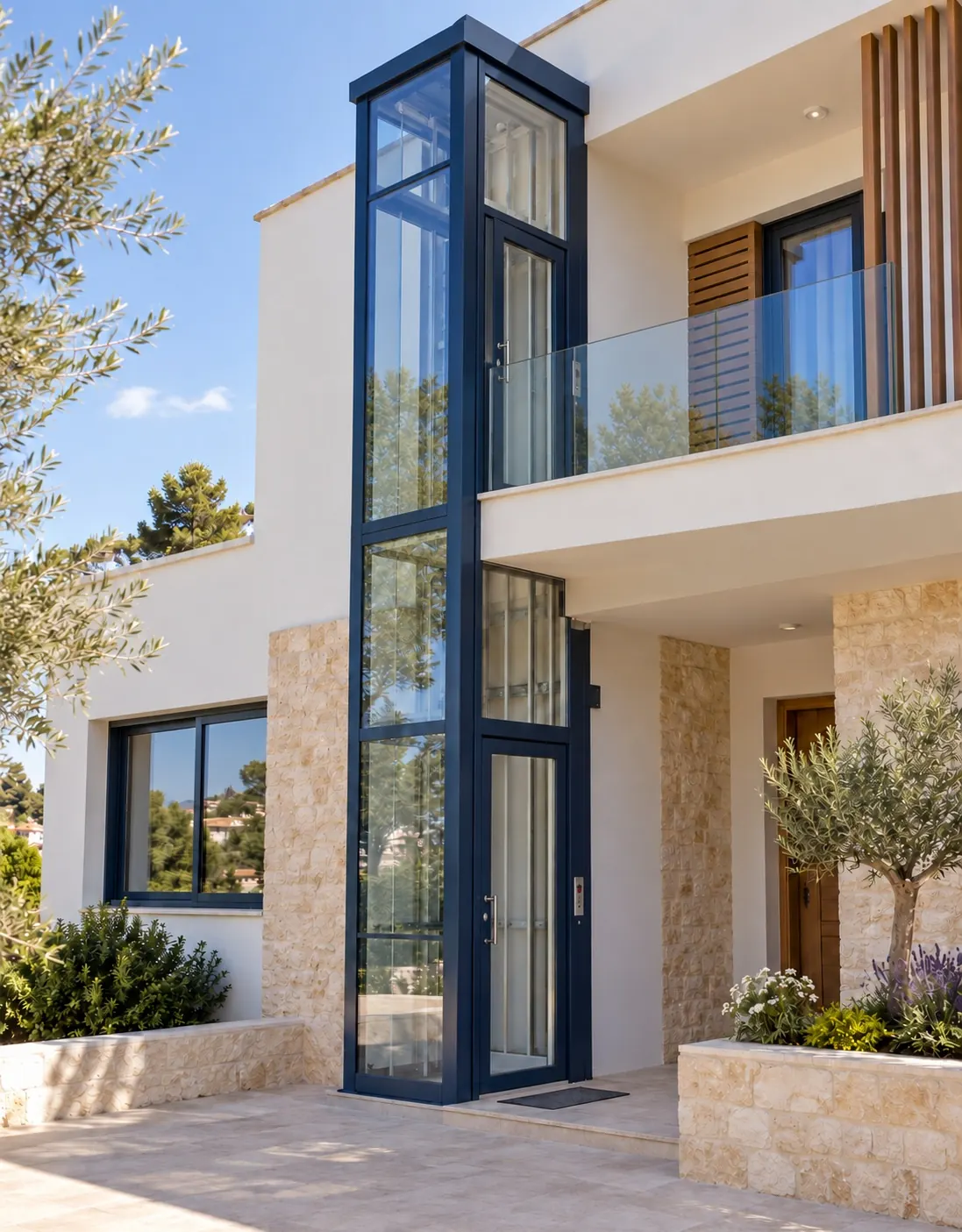
When a property owner or developer sets out to remove architectural barriers, the first word that usually comes to mind is "lift". However, in most residential buildings and small commercial premises, what is actually needed is a platform lift. The confusion between the two terms is common and frequently leads to oversized projects, unnecessary building work and disproportionate budgets.
In this article we explain the technical differences between a platform lift and a conventional lift with rigour, so you can make an informed decision about the equipment that best suits your project.
What is a platform lift?
A platform lift is a vertical transport device designed to overcome level changes over a small number of floors in homes, shops and public buildings. It is characterised by technology that is simpler and more compact than that of a conventional lift, without compromising on safety or regulatory compliance.
Its main technical features are:
- Reduced speed: this type of equipment is designed to travel at a maximum of 0.15 m/s, which guarantees a safe and smooth ride.
- Open carrier: the platform is not a fully enclosed cabin like a conventional lift's; the landing doors are manual and simple to operate, which drastically reduces the space required.
- Self-supporting structure: the equipment itself bears the loads, so it does not require the construction of a full structural shaft.
- No machine room: the drive mechanism (screw or hydraulic) is integrated into the equipment itself or a compact cabinet, eliminating the need for a machine room.
- Simplified installation: it requires minimal civil work: an electrical connection, a small pit or none at all, and structural anchor points.
What is a conventional lift?
A conventional lift is a vertical transport system designed for taller buildings and high traffic. It has a fully enclosed cabin with cabin and landing doors at every stop, and is designed to transport a large number of people continuously.
Its main technical features are:
- High speed: typically between 0.6 and 1.6 m/s (or higher in tall buildings), to optimise waiting times in buildings with many floors.
- Enclosed cabin: it requires a full shaft with landing doors at every floor and a cabin with automatic doors.
- Deep pit and headroom: they require a deep pit (usually over one metre) and considerable clear height above the top landing, which demands significant civil work.
- Stricter regulations: they are subject to more stringent regulation regarding inspections, maintenance and certification, given their intensive use.
- Significant civil work: they require the construction of a complete structural shaft, with a deep pit and overhead clearance.
Key differences between a platform lift and a conventional lift
Below we summarise the most relevant differences you should consider when evaluating which equipment you need:
- Speed: the platform lift travels at a maximum of 0.15 m/s; the conventional lift, typically between 0.6 and 1.6 m/s. The platform lift is clearly slower — around 20 seconds per floor — but over a 2-3 stop journey the total travel time remains perfectly acceptable for residential or low-traffic use.
- Space required: the platform lift needs no enclosed shaft or machine room; the conventional lift requires a complete structural shaft.
- Civil work: the platform lift requires minimal work (anchors and electrical connection); the conventional lift involves building a shaft, a deep pit and considerable overhead clearance.
- Cost: a platform lift represents a fraction of the cost of a conventional lift, both in installation and maintenance.
- Regulations: the platform lift is marketed under the Machinery Directive 2006/42/EC (with the harmonised standard EN 81-41 for vertical lifting platforms); the conventional lift falls under the Lifts Directive 2014/33/EU, transposed in Spain by Royal Decree 203/2016, with more demanding requirements.
- Maintenance and inspection: since July 2024, both types of equipment are subject to registration, maintenance and regulatory inspections under the ITC AEM 1 (RD 355/2024); the conventional lift additionally tends to require more frequent servicing due to its higher speed and usage.
When to choose each one?
Platform lift: the ideal option for most projects
The platform lift is the optimal solution when:
- The building has 2 or 3 stops (ground floor and 1-2 upper floors).
- It is a single-family home or a small residential building.
- Space is limited and a full shaft cannot be dedicated to the equipment.
- Budget is a decisive factor.
- You need to comply with accessibility regulations in a public or commercial building with few floors.
Conventional lift: necessary in tall, high-traffic buildings
A conventional lift is necessary when:
- The building has 4 or more floors or intense foot traffic.
- It is a tall commercial building, a hospital or a residential building with high demand.
- The project requires continuous and rapid transport for a large number of users.
Why many projects don't need a conventional lift
The reality is that the vast majority of residential buildings and small commercial premises have 2 or 3 stops. In these cases, a conventional lift is oversized equipment: its speed, enclosed cabin and infrastructure are designed for tall, high-traffic buildings, not to overcome a one- or two-floor level change.
A platform lift perfectly covers this need: it transports people and goods between floors with complete safety, at a speed appropriate to the travel distance, and with a much smaller investment and footprint. Choosing the right equipment is not a compromise — it is a technically and economically sound decision.
In most low-rise residential and commercial projects, the platform lift is not a "second-best" alternative: it is the technically correct, economically sensible and regulatory-compliant solution.
Conclusion
Understanding the difference between a platform lift and a conventional lift is the first step towards making the right decision. It is not about choosing "the best" in the abstract, but about choosing what best suits your space, your needs and your budget. At AKROS Movilidad we do not manufacture equipment: we prescribe it, select it, install it, commission it and maintain it. Our job is to analyse your project and recommend the equipment you genuinely need, without oversizing or underutilising it.
Shall we study your project?
Our technical team analyses your space and prescribes the equipment that best suits your needs, with no obligation.
Request free advice