
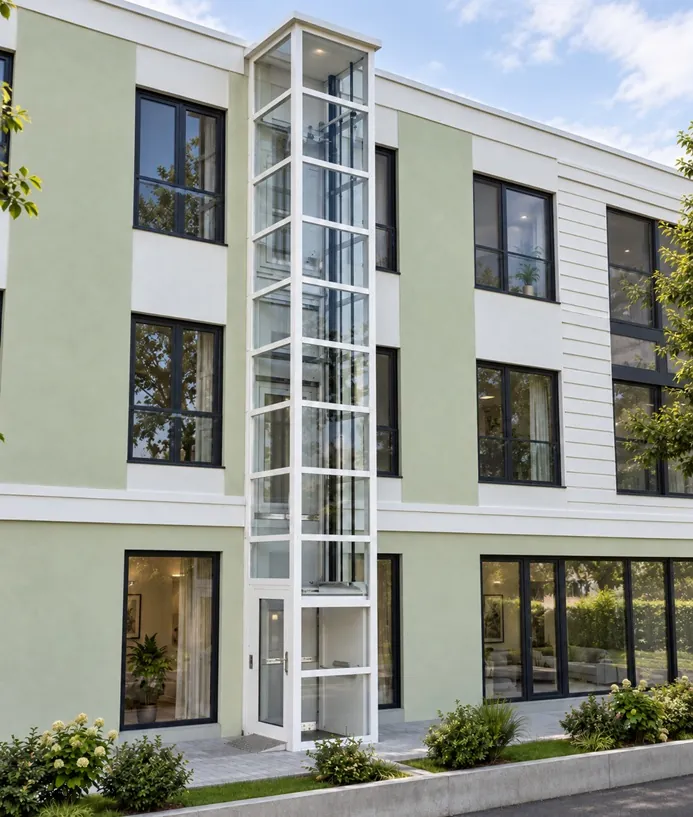
The most common concern we hear from homeowners who want to install a platform lift in an already built home is always the same: "Am I going to have to do a huge amount of building work?". The answer, in the vast majority of cases, is no. Platform lift technology has evolved to such an extent that it is now possible to add accessibility to an existing home with minimal intervention and without turning the house into a building site for months.
Can you install a platform lift without major work?
Yes. Unlike a conventional lift, which requires the construction of a full structural shaft, a deep pit and considerable overhead clearance, a platform lift is a self-supporting unit. This means the equipment's own structure bears the loads and does not need to rely on complex civil work.
Modern platform lifts are designed specifically to integrate into existing homes. Their installation comes down to three basic elements: an electrical connection, a small pit (or none, depending on the model) and structural anchor points at each floor. There is no need to knock down walls or open holes through the floor slabs as would be the case with a conventional lift.
Types of installation: interior vs exterior
Interior installation
When the home has a usable indoor space — a staircase with side clearance, a space under the stairs or a sufficiently wide passageway — the platform lift is installed indoors with a minimal footprint. The self-supporting structure of the equipment takes up very little space, and there is no need to build a traditional enclosed shaft.
Exterior installation
When there is no space indoors, the platform lift can be installed on the exterior of the home, attached to the façade. In this case, no interior work is carried out: the equipment is anchored to the façade and accesses each floor through an opening made in the external wall. This option is particularly attractive for single-family homes with an accessible façade, as it avoids any intervention indoors altogether.
Screw-drive platform lifts
Screw-drive platform lifts are one of the most suitable technologies for existing homes. Their drive system is based on a screw-and-nut mechanism that moves the platform safely and progressively, with no need for hydraulic oil or a bulky motor.
Their main advantages are:
- No hydraulic oil: there is no risk of leaks or need for reservoirs, which simplifies maintenance and reduces environmental impact.
- Low maintenance: the screw system is mechanically simple and robust, with few components subject to wear.
- Compact: the drive is integrated into the equipment itself, with no need for a machine room.
- Weather-resistant: ideal for exterior installation, as the screw system withstands exposure to the elements well.
Hydraulic homelifts
Hydraulic homelifts use a drive based on a hydraulic piston that moves the platform with a smooth and progressive motion. They are an excellent option when particularly quiet and comfortable operation is sought.
Their main advantages are:
- Smooth operation: the hydraulic drive offers a progressive, vibration-free movement, ideal for interiors.
- Robustness: it is a proven and reliable system with a long service life.
- Suitable for heavier loads: when heavier loads need to be transported, the hydraulic system offers excellent performance.
What building work is actually needed?
The building work required to install a platform lift in an existing home is minimal and very specific:
- Electrical connection: a power supply line appropriate to the equipment's rating, similar to that of any high-power household appliance.
- Reduced or non-existent pit: depending on the model, a pit of a few centimetres is needed at the lowest stop, or none at all. Nothing like the deep pit of a conventional lift.
- Structural anchors: fixing points at each floor to secure the equipment to the building's structure. These are targeted interventions, not structural alterations.
- For exterior installations: an opening in the façade at each floor for access, with the corresponding sealing and finishing.
There is no need to open holes in the floor slabs, build an enclosed shaft or excavate a deep pit. The civil work is reduced to the bare essentials.
An important caveat: although the building work is minimal, the installation may require a building permit or prior notification depending on the municipality and, if the equipment affects common elements or the façade of a shared building, authorisation from the community of owners. These formalities are identified during the initial technical study so that the project moves forward without surprises.
Installation time
The assembly time for the equipment itself is short: around 2-3 days under normal conditions, although this can vary depending on the model and configuration. To this must be added the time to prepare the civil work (pit, anchors, electrical connection) and any permit formalities, which depend on the characteristics of each home, but in no case compare with the work that a conventional lift would require.
The result is that, in most cases, a home can have a fully operational platform lift within a few weeks of the start of works, including the preparatory civil work.
Architectural considerations
Beyond the building work, a fundamental aspect is the architectural integration of the platform lift. A platform lift does not have to be an alien element in the home: current models offer finishes, materials and designs that allow the equipment to blend into its surroundings, both indoors and on façades.
At AKROS we study each project so that the platform lift not only fulfils its function, but also integrates aesthetically into the home. This includes the choice of model, finishes, location and, in the case of exterior installations, the treatment of the façade and enclosures.
Installing a platform lift in an already built home is not a major construction project: it is a precise, fast and controlled intervention that adds accessibility without altering the essence of your home.
Conclusion
The idea that installing a platform lift involves enormous building work is a myth inherited from the era when the only option was a conventional lift. Today, screw-drive and hydraulic platform lifts allow accessibility to be added to an existing home with minimal intervention, in short timeframes and with a controlled architectural impact. At AKROS Movilidad we do not manufacture equipment: we prescribe the most suitable one for your home, install it, commission it and maintain it, accompanying you throughout the entire process.
Shall we study your project?
Our technical team analyses your space and prescribes the equipment that best suits your needs, with no obligation.
Request free advice