
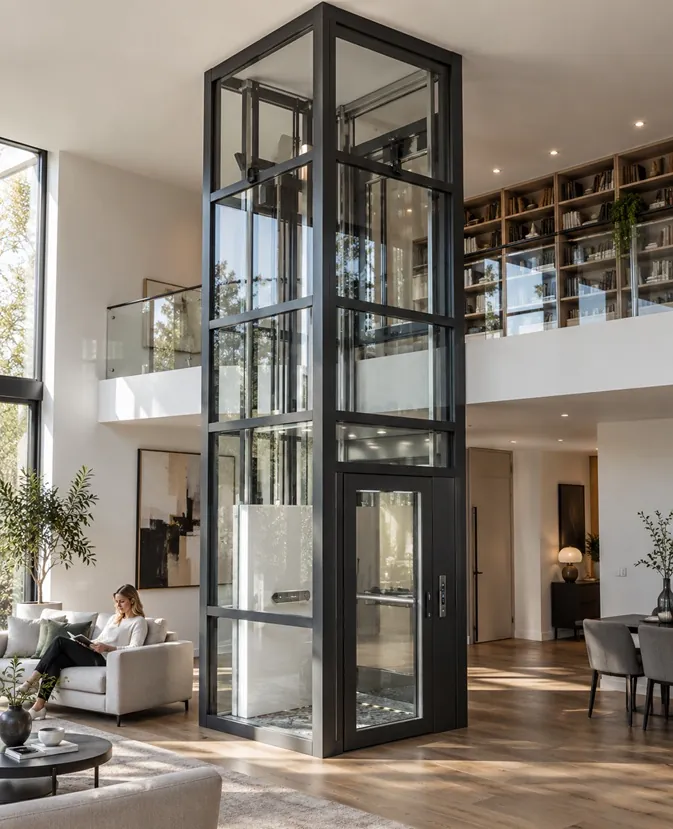
When a property owner or developer considers installing lifting equipment, price is usually the decisive factor. And rightly so: the economic difference between a platform lift and a conventional lift is so significant that, in many cases, it determines the viability of the project. In this article we review the price ranges of both types of equipment with honesty, the factors that influence them and the real cost over their service life.
How much does a platform lift cost?
The price of an accessibility platform lift, installed and in working order, falls within an approximate range of €8,000 to €25,000, depending on the model, the number of stops, the technical specifications and the finishes. This figure includes the equipment, installation and commissioning.
It is important to note that these are indicative ranges: the final price depends on the specific characteristics of each project. A 2-stop screw-drive platform lift with standard finishes will sit at the lower end of the range, whilst a 5-stop hydraulic platform lift with premium finishes and exterior installation will approach the upper end.
How much does a conventional lift cost?
The price of a conventional lift, installed and in working order, starts at approximately €25,000 and can exceed €60,000 in multi-storey buildings. This figure is notably higher because it includes not only the equipment but all the civil work that accompanies it:
- Construction of the full structural shaft.
- Deep pit at the lowest stop.
- Considerable overhead clearance (free height above the top landing).
- Specific electrical installation.
- More stringent regulatory processing and certification.
The price difference lies not only in the equipment itself, but in all the infrastructure that surrounds it. A conventional lift is a civil engineering project, not a simple installation.
Factors that influence the price
Both for a platform lift and a conventional lift, the final price depends on several factors:
- Number of stops: each additional stop adds cost, both to the equipment and to the preparatory work.
- Load capacity: higher-capacity equipment requires more robust components.
- Interior or exterior installation: exterior installation may require façade treatments and specific enclosures.
- Finishes: materials, colours and design options influence the final price.
- Drive type: in platform lifts, the screw-drive and hydraulic systems have different prices and characteristics.
- Required civil work: in the case of a conventional lift, the construction of the shaft, the pit and the overhead clearance is the most significant cost factor.
Installation and civil work costs
This is where the difference between the two types of equipment becomes most evident:
- Platform lift: assembly of the equipment usually takes around 2-3 days under normal conditions and the civil work is reduced to an electrical connection, a minimal or non-existent pit and structural anchors. The cost of the work is a fraction of the total.
- Conventional lift: the civil work (shaft, deep pit, overhead clearance) can represent a very significant share of the total project cost and extend the timeline over weeks.
Maintenance costs
Maintenance costs are also notably different:
- Platform lift: since July 2024 it is subject to the ITC AEM 1: four-monthly maintenance in single-family homes and periodic inspections every six years, generally simpler and more economical than those of a conventional lift. The screw-drive system, in particular, requires reduced maintenance as it uses no hydraulic oil.
- Conventional lift: it requires regular preventive maintenance and, in addition, mandatory periodic regulatory inspections under the Spanish ITC AEM 1 regulation (every 2, 4 or 6 years depending on the type of installation).
Return on investment
Beyond the direct cost, the return on investment that lifting equipment provides must be considered:
- Property value: a home or commercial premises with vertical accessibility increases its market value and its appeal to buyers and tenants.
- Regulatory compliance: in public-use buildings and spaces, accessibility is a legal obligation; the cost of non-compliance can translate into fines, discrimination claims or problems with operating licences.
- Quality of life: in the residential setting, the comfort and autonomy that a platform lift provides are immeasurable, but decisive for being able to continue living in one's own home over the years.
The total cost of ownership of a platform lift — installation plus maintenance over its service life — can be less than half that of a conventional lift for the same travel distance. Choosing the right equipment is not just about paying less today: it is about paying less throughout the equipment's life.
Conclusion
The price difference between a platform lift and a conventional lift is substantial, and is not limited to the equipment: it extends to the civil work, maintenance and total cost of ownership. For most homes and low-rise buildings, the platform lift offers the same essential functionality at a fraction of the cost. At AKROS Movilidad we do not manufacture equipment: we study your project and help you find the solution that offers the best value, without oversizing the investment or compromising on quality.
Shall we study your project?
Our technical team analyses your space and prescribes the equipment that best suits your needs, with no obligation.
Request free advice